Status and Authenticity
(Note: for now, the footnotes only look right if you click into the post.)
Epistemic status: ideas on this post have been forming over a roughly a year or so, about 80%-90% sure on this one.
1
One thing that my more ambitious friends tend to talk a lot about is that we should focus on creating vs. consuming, kind of like the guy in this xkcd comic:
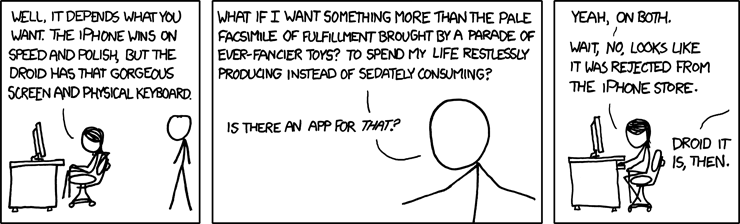
This is a sentiment that I have myself held before, though I could never quite explain exactly why I had that belief. Even now, I feel somewhat torn about this one.
The root of this conflict is that I perceive the rhetoric around creating and consuming to be very similar to be the rhetoric around authenticity, which I feel is problematic.
There is a very strong message today for people to live authentically and not to worry about what others think of you. I actually think this trend is all well and good.
However, at the same time, pretty much everyone readily evaluate people based on their social status. “That hardcore gamer who still lives in his parents' basement”, “that late-30s woman who's not yet married”, “that dude who dropped out of school”, we use these caricatures all the time in a condescending way, and think of this as the normal state of things.
I think this type of judgement, combined with the message to live authentically, forms a Catch-22. If someone pursues what they want to do all the time, they could well end up with a social status considered undesirable. However, if they ever feel bad about it, then they are too anxious and “too worried about what others think”. It's a lose-lose situation, you feel bad no matter what you do.
2
“Well, that seems all well and good, but isn't it all based on the assumption that what people like to do won't lead them to a positive social image? If they only searched inside to find what they really like, then they'll certainly be appreciated eventually”.
Perhaps, but from my observation, most people simply want to do what's fun to them, and entertainment fills that role in its entirety.
Indeed, by definition, consuming entertainment is more fun than things that are not entertainment for most people. If going about everyday life for most people was itself more fun than entertainment, then entertainment ceases to have much (though not all) of a reason to exist.
A limited few prestigious spots are reserved for people who consume entertainment well, like through streaming or winning game competitions. However, those spots are one among hundreds of thousands, it's not really sensible to expect people to reach those positions “if only they are passionate enough”.
Then, if one were to truly look down on people who doesn't seem to be doing something “productive”, then one can't really believe in the form of authenticity that's “do what you like to do” without perpetuating the Catch-22. For a lot of people, their authentic self is not something that's valued by others[^1].
3
One idea I don't want to endorse is that a person's preferences of things to do is unchanging over time. A person may start wanting meaningful friendships enough that they stop playing games and go join a meetup group. Someone else might have enough fun travelling that they leave someplace they volunteer at to travel. From new thoughts and experiences, the set of personal values can shift to produce different behaviors out of genuine desire.
On the other hand, I think it's possible someone's personal desires are not connected to something valued by society. As long as it doesn't infringe on anyone, then so be it. If someone values “be yourself” as sacred, then they should withhold the type of judgement that looks down on them.
(I think that condescending in general is bad, but do understand if the implications of “be yourself” as sacred can be uncomfortable to some. For example, the arguments of the tragedy of commons are legitimate, and so are issues of substance abuse. I think these are great things to consider when deciding on personal viewpoints.)
4
(This post is mainly pointing out a social phenomenon I don't like. This part is that awkward place where I don't feel super comfortable or qualified giving individual advice, but will try my hand at a take anyways since I think it could be useful.)
Resolving the Catch-22 of status and authenticity in society requires a significant number of people to realize the mismatch between the two. This will probably be a slow progress. For an individual caught in the contradiction, how should they navigate the feeling of a lack of fulfillment?
I think first of all, understanding whether one's motivation comes from individual desires or social status could help. Here are some useful questions:
- Did you want to do something because it's 1) it's what a reputable/prestigious person would do 2) it's enjoyable, 3) to learn more about it or 4) a tradeoff of a bunch of different factors?
- Actions often speak better than words. Does your actions match your theories of why you are doing it?
- If it's from social status, do you think that it comes from a reasonable place[^2]?
- If it's a tradeoff of between a bunch of factors, do you agree with the value you place on each factor?
And broadly:
- What's your take on what is meaningful to pursue?
With these answers, however rudimentary the first drafts are, at least they are a step beyond the never-ending struggle between being yourself and being accepted.
[1] Throughout the piece I've been using the words “Authentic” and “Being true to self” interchangeably, as these tend to be used as synonyms in everyday conversation. However, there's some experimental evidence (1, 2, 3) that people feel more “authentic” when they involve a version of themselves that's more socially ideal under the five-factor personality model (high agreeableness, extroversion, openness to experience, conscientiousness. Low neuroticism.). On the other hand, the correlation with their everyday personality is much lower. Perhaps people feel that the authentic version of themselves is the part of themselves that's socially their best? Subjective authenticity has significant correlations with subjective-wellbeing, so there is a reasonable argument that achieving societal ideals in certain aspects of personality do lead to more happiness. Regardless, I feel that the findings indicate that “Authentic” may be a particularly confusing word to use when it comes to talking about oneself. Matthew D. Liberman's “Social” may be a helpful book on the subject.
[2] Not a trick question, the answer can easily be yes. Status is a controversial word to use here because it often evokes the negative image of “status chasing”, but to improve one's status often points to productive things like meeting a minimum of presentable-ness, helping others, and being a good person in general. As ugly as status conflicts can be, it's also a fundamental building block of human societies that often points the way for participants to benefit others (albeit it is sometimes a lagging indicator). The argument of this post is not that status is bad, but that it can potentially lead people astray and is an important thing to be aware of.
—
Categorized under: #psychology, #sociology, #philosophy